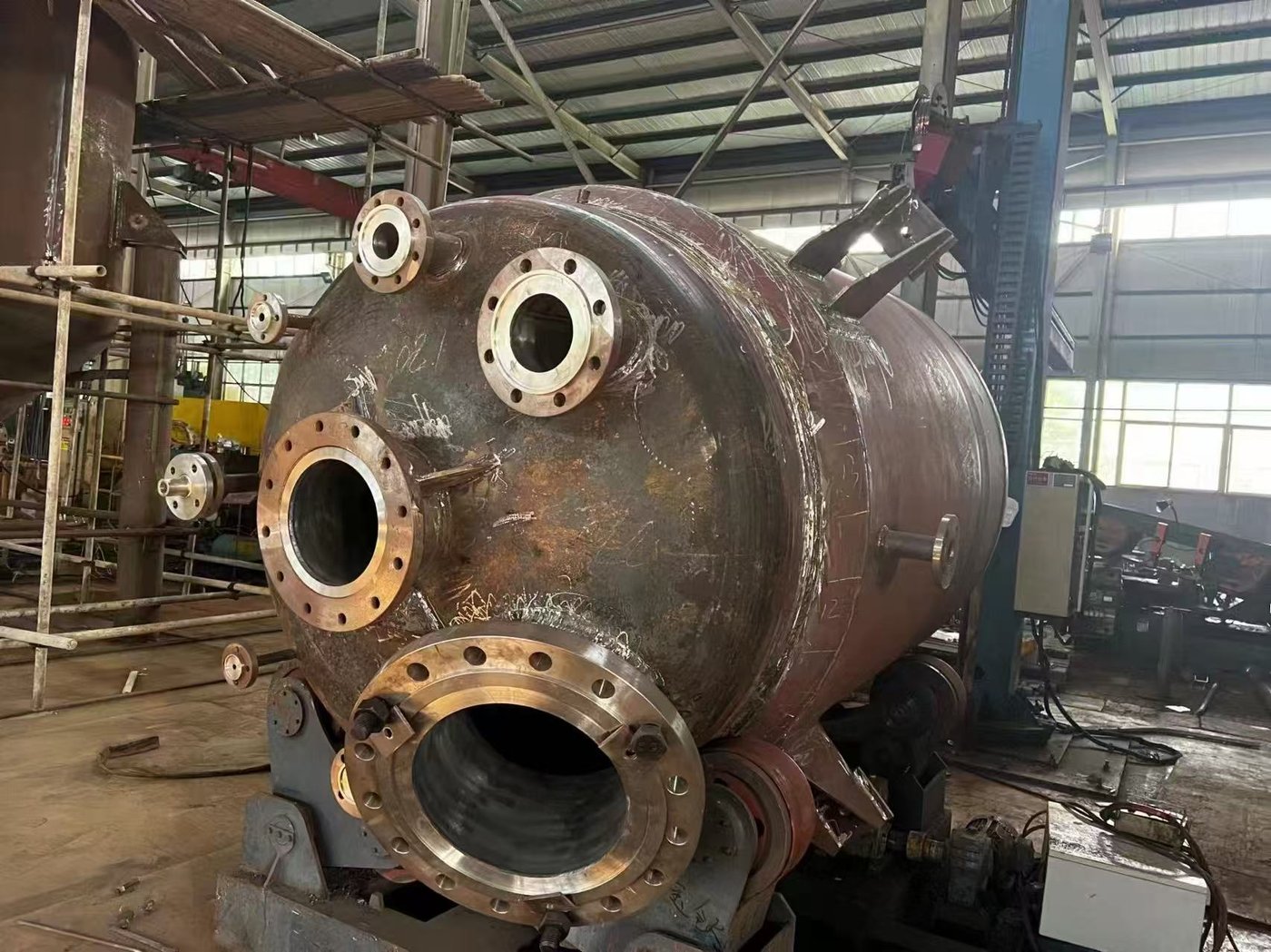
Buying a reactor from China direct is cheaper on paper — a 3,000 L jacketed glass-lined vessel runs USD 8,000–14,000 ex-works from the factory, and cutting out the middle layer takes a fee off that number. Buying through a sourcing agent costs that fee back and buys three things in return: a numbered specification sheet you approve before fabrication starts, an inspector standing at the high-voltage test recording the figure in kV, and one named person still answering emails after the vessel lands. Neither route is wrong. The decision turns on how much of the factory you can verify yourself.
1. What "direct" and "agent" actually mean here
Direct means you hold the contract with the entity that owns the furnace, the autoclave and the pressure-vessel manufacturing licence. Agent means you hold the contract with an intermediary who specifies, audits, inspects and ships, and is paid for that work.
The distinction collapses in one very common case: a supplier that presents itself as a factory, but whose business licence scope reads trading, whose workshop is a rented bay, and whose vessels are built by a subcontractor several hundred kilometres away. That supplier is an agent with worse paperwork and no inspection duty.
2. Going direct: what you gain
The obvious gain is price. Any intermediary margin sits inside the number you were quoted, so removing it moves the same vessel closer to the factory-floor price. On a 3,000 L glass-lined reactor that margin is real money, and on a multi-unit order it compounds.
The second gain is engineering access. A direct line to the draughtsman shortens the loop on a nozzle layout or an agitator change from days to hours. If your duty is unusual — a half-pipe coil jacket, a Hastelloy wetted strip, a sterile-grade mechanical seal, a GMP mirror-polished internal finish — the person who can actually change the drawing is on the other end of the call.
The third gain is capacity visibility. Buying direct lets you ask where your vessel sits in the queue behind whatever is currently in the lining furnace, and get a straight answer about the delivery date on the contract rather than a date relayed second-hand.
3. Going direct: what it costs you
You become the inspector, and you are inspecting from 5,000 km away. Chinese glass-lined shops are not interchangeable: the difference between a vessel that runs fifteen years and one that chips at the second nozzle in month eight is process control you cannot see in a quotation.
Specification drift is the standard failure. The quotation says 316L, the general arrangement drawing says 304, and the nameplate gets printed from the drawing. Nobody in your office catches it, because nobody is reading Chinese drawings at 2 a.m. against a quotation from three months ago.
Payment risk is the second. A 30 % deposit wired to a company you have never visited, against a proforma with no licence number on it, is an unsecured loan. The balance is usually released against a copy of the bill of lading, which means it is released before anyone has confirmed the lining thickness in mm or the jacket hydrotest pressure in MPa.
After-sales is the hardest. A lining chip found at commissioning is a warranty claim; a warranty claim across an ocean, with no local presence and no leverage, is a negotiation you will probably lose. If you never visit the shop, you are also relying on a video call in a workshop where the vessel in the background may not be yours.
4. Going through an agent: what you gain
Three things, and only three: verification, specification translation, and a person on the ground when the vessel is wrong.
Verification means hold points with a name against them. Witness the high-voltage test on the lining and record the kV figure. Take lining thickness readings in mm at the nozzles and on the dished head, not just at the easy-to-reach shell. Confirm the jacket test pressure on the record against the design pressure in MPa on the sheet you approved. Check agitator run-out in the empty vessel at design speed.
Specification translation means your duty — design pressure, operating temperature, jacket type, sealing arrangement, and the media with its exclusions — becomes a numbered confirmation sheet the factory builds to and you sign off. Glass-lined has hard limits that a vague enquiry will not surface: no hydrofluoric acid or fluoride-bearing media, no phosphoric acid at 30 % or above 180 °C, no strong alkali above pH 12 at 100 °C, and cold shock held to 110 °C with heat shock to 120 °C.
The third gain is mundane and worth paying for: someone chasing a vessel that is three weeks overdue, in the factory's language, in person, at the gate.
5. Going through an agent: what it costs you
You pay a fee, and the fee is not always visible. Ask any intermediary to state their remuneration as a percentage of the ex-works price, in writing, before the proforma. An agent who will not is a hidden line item, not an advisor.
Conflict of interest is real. If the agent is paid commission by the factory, their incentive is to place the order, not to fail the vessel at inspection. A sourcing office that is paid by the buyer has the opposite incentive, and you should test which one you are talking to.
And an agent with no engineering staff is a freight forwarder with an opinion. If the person quoting you cannot read the difference between a packed seal and a mechanical seal on a drawing, they cannot protect you on a closed Type F vessel with a GMP finish.
6. Three checks that work either way
- Ask for the business licence scope and the special-equipment pressure-vessel manufacturing licence number, and confirm the class covers your design pressure. A trading scope means you are talking to an agent, whatever the letterhead says.
- Ask who signs the inspection report. A factory QC stamp is a self-assessment. An independent inspector's signature — SGS, BV, TÜV, or your own engineer — is evidence. Either is acceptable; only one is evidence.
- Ask when the balance is due. Against a bill of lading copy is normal and risky. Against an inspection release after the high-voltage test is better, and a factory that refuses it is telling you something.
7. When the cheaper route is the right one
Go direct when you have bought from that factory before, or when the order is large enough to justify flying out for the final acceptance test. Go direct on a standard open Type K vessel with a packed seal and a water-like duty, quoted at the bottom of the range. The risk you are carrying is small and the fee buys you little.
Pay for an agent when it is a first order with an unfamiliar shop, when the vessel is a closed Type F with a mechanical seal and a polished hygienic internal finish, when your nozzle layout is non-standard, or when the order spans several units and ancillary equipment — storage tanks, exchangers, condensers — from more than one workshop. That is the case where a single accountable party is worth more than the fee.
What to do next
Before you sign a proforma, ask for the numbered specification confirmation sheet — design pressure in MPa, design temperature in °C, lining thickness in mm, high-voltage test in kV, seal type, agitator type and power. If the supplier sends a model number and a price instead, you are buying a catalogue entry, not a vessel. Then decide whether you need a pair of eyes in China or a signature on the test record, and price that separately from the reactor.