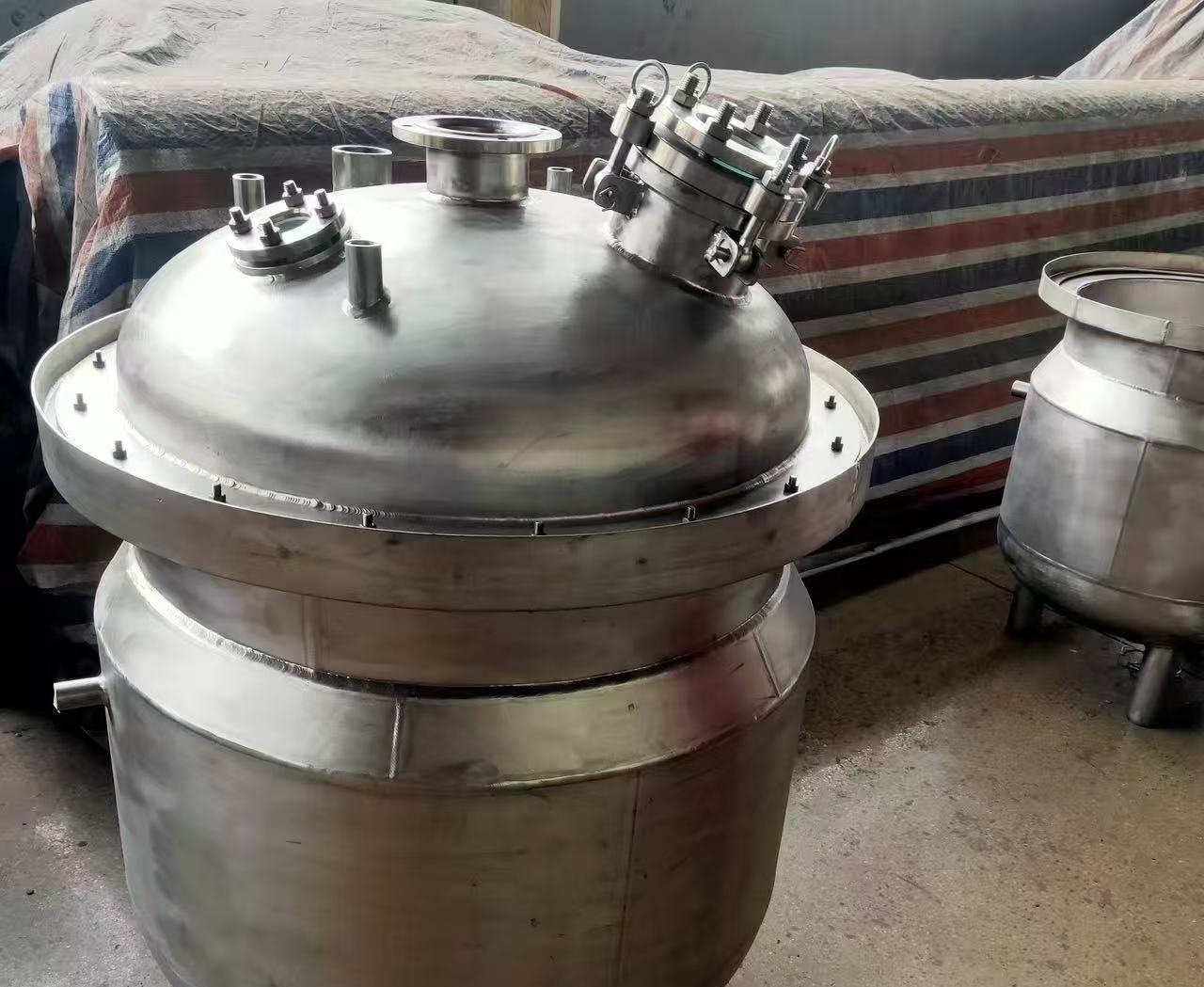
Do not release a deposit on a glass-lined, stainless steel or PTFE-lined reactor from China until you hold five documents: a numbered specification confirmation sheet, a signed drawing set, a material and lining certificate schedule, an inspection and test plan, and a proforma invoice with a payment schedule tied to document milestones. The specification sheet alone must carry design pressure in MPa, design temperature in °C, glass lining thickness in mm and high-voltage test level in kV. On a 3,000 L jacketed vessel in the USD 8,000–14,000 ex-works band, those four numbers are the entire difference between two quotations.
1. The numbered specification confirmation sheet
This is the only document that states what you actually bought. It should name the model series — Type K for an open vessel with a removable cover, Type F for a closed vessel with an integral head — the nominal volume in litres between 50 and 30,000 L, and then the duty.
Demand four figures as a minimum: design pressure in MPa for the inner vessel and for the jacket separately, design temperature in °C, glass lining thickness in mm, and high-voltage test level in kV. Add the thermal shock limits, which for standard glass lining run to cold shock ≤ 110 °C and heat shock ≤ 120 °C.
The media clause matters as much as the numbers. A correct sheet states what the lining suits — inorganic and organic acids, organic solvents and weak bases at various concentrations — and what it does not: hydrofluoric acid, fluoride-bearing media, phosphoric acid at 30 % or above over 180 °C, and strong alkali above pH 12 at 100 °C. If your duty sits near any of those limits, the sheet is where you find out, not the reactor.
Every later document refers back to this one by number. A sheet without a revision number and a date is a brochure.
2. A signed drawing set
Ask for the general arrangement drawing, the nozzle and manway schedule with sizes and flange standard, the agitator drawing and the seal drawing, all stamped with the supplier's chop and a revision number. The seal is a matched assembly, not a catalogue part: it is selected against shaft diameter, agitator speed, design pressure in MPa and the media, and it should be drawn with its stationary seat and wetted materials named.
The drawing set is also where material choices stop being adjectives. For stainless vessels it fixes the shell material — carbon steel, 304 or 316L, titanium, duplex stainless, Hastelloy or clad plate — the heat transfer arrangement (jacket, inner coil, immersion tube or half-pipe coil), the internal finish (GMP mirror polish where the duty needs it) and the agitator type: paddle, anchor/frame, disc turbine, hydrofoil, impeller or dispersion disc.
For a PTFE-lined vessel the drawing must name the lining — PFA, PTFE, ETFE (F40), ECTFE (F30) or FEP (F46) — and the process, spray or rotational coating, plus the lining colour if you are buying a lined storage tank.
3. A material and lining certificate schedule
Before you pay, you need the commitment in writing: which parts get certificates, to which standard, and which heat numbers appear against which drawing item. For wetted metal that normally means mill certificates to EN 10204 3.1, with heat numbers traceable to the plates and forgings listed on the general arrangement.
For a glass-lined vessel, the schedule should name the lining batch, the measured thickness in mm at flange and shell positions, and the high-voltage test record in kV, nozzle by nozzle and flange by flange, with date and inspector. For PTFE-lined work, the lining material certificate and the coating method. For the fittings, the gasket specification — PTFE and rubber-encapsulated PTFE where the duty requires it — and the bolt grade and coating.
The certificates themselves arrive during fabrication. The schedule that binds the supplier to produce them has to exist before the deposit leaves your account.
4. The inspection and test plan
The ITP is a one-page table of hold points, witness points and review points, and it decides who signs what. It should cover the hydrotest of the inner vessel and the jacket, the high-voltage test on the lining, agitator shaft runout, the seal leak test and the final dimensional check against the drawing.
Name the inspector: SGS, your own engineer, or us attending on your behalf. What matters is that the hold points are written down and that fabrication stops there. A test performed without a witness and without a signed record is a test you will pay for twice, the second time on site.
5. The proforma invoice and payment schedule
The invoice must state the price ex-works, the Incoterm and named port, the HS code, the packing method for sea freight, the warranty period and the spare parts list. Then the clause that protects the other four documents: each payment tranche tied to a named document or milestone, not to a photograph of a vessel on a factory floor.
Put the specification sheet number on the invoice itself. If a supplier will not print that number on a commercial document, the specification is not binding and the deposit is a gift.
When the five are not all ready at once
Three of them — specification sheet, drawing set, invoice — must be complete before the deposit. The certificate schedule and the ITP must be agreed before the deposit, but their contents are filled in during fabrication. Pretending all five arrive as finished paperwork on day one is how buyers end up with a signed sheet nobody can meet.
Haggling over price before these five exist is the wrong order. Two quotations for a 3,000 L jacketed glass-lined reactor with a mechanical seal, one at the bottom of the USD 8,000–14,000 band and one at the top, are rarely the same vessel. The spec sheet is what turns the gap into a line-by-line comparison of steel grade, lining thickness, seal type, agitator and test level.
What to do next
- Send one request: specification confirmation sheet, drawing set with revision numbers, certificate schedule, ITP and proforma invoice, delivered as a single PDF pack.
- Read the media clause on the spec sheet before anything else. If it excludes your duty, stop there.
- Hold the deposit until documents 1, 2 and 5 are in hand and 3 and 4 are agreed in writing.
- Quote the spec sheet number in the payment instruction, so the bank record matches the engineering record.
- If a supplier answers with a catalogue page, that is your answer.