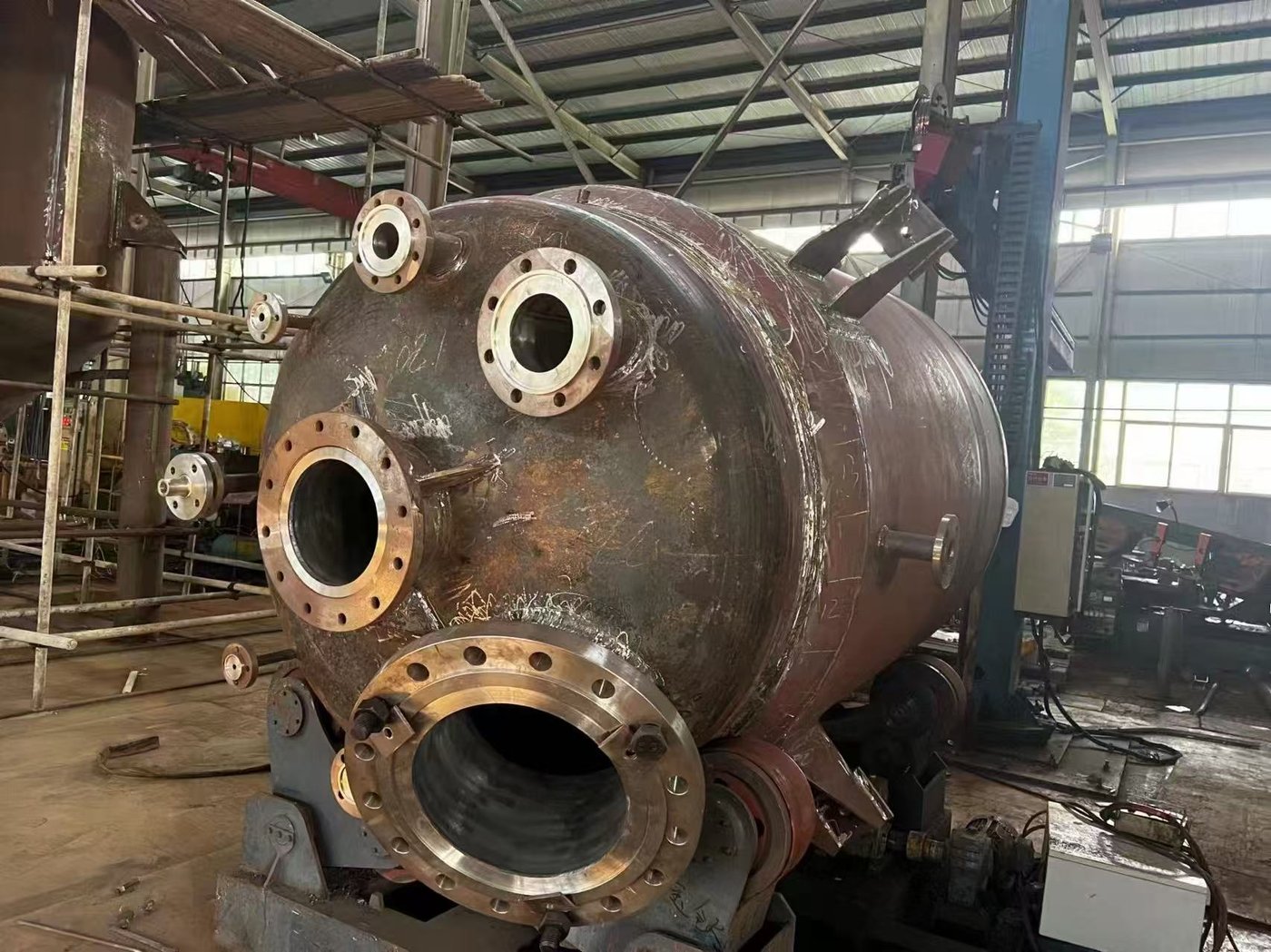
A new 3,000 L jacketed glass-lined reactor with a mechanical seal from China costs USD 8,000–14,000 ex-works; a used vessel of the same nominal volume is only the cheaper decision when its glass lining measures and spark-tests clean, its documents trace to a named design standard such as GB/T 150-2011 or ASME VIII Div. 1, and price plus re-commissioning stays well below that band. Remove any one of those three conditions and new build wins on total cost, not just on comfort.
That is the argument in one paragraph. What follows is how we run it on a live enquiry, line by line.
1. Compare landed cost, not asking price
A used vessel is quoted as-is, where-is. Six lines decide the real number: purchase price, freight and rigging to your site, lining repair or re-lining, seal and agitator refurbishment, documentation (design check, re-testing, re-certification), and the downtime between arrival and first batch.
A new 50–30,000 L vessel quoted ex-works carries its own six lines, and we break them out so you can put our number next to anyone else's. The difference is that on a new build, the refurbishment and documentation lines sit inside the price. On a used vessel they do not, and nobody quotes them until the vessel is on your loading bay.
2. Where used genuinely wins
Used is defensible in four situations, and honest buyers should say so.
- A stainless 304 or 316L vessel for a non-critical duty, where the wetted surface can be re-polished and inspected without argument.
- A PTFE- or PFA-lined vessel, where the lining is a serviceable item and re-coating in PFA, ETFE (F40), ECTFE (F30) or FEP (F46) is a known route rather than a rebuild.
- A short campaign — one product, limited batches — where the vessel does not need to survive a ten-year depreciation cycle.
- A spare that sits behind an identical unit already running in your plant, so spares and drawings already exist on your side.
Outside those four, the saving has to be large enough to absorb a re-lining. That is a high bar on a glass-lined vessel.
3. Risk one: the lining has a history you cannot see
Glass lining is the wear part. It is not structural, but once it fails, the steel underneath meets the process media, and the failure is usually a pinhole found by a batch going off-spec rather than by an alarm.
The enamel is also not universal. It is specified for inorganic and organic acids, organic solvents and weak bases, and explicitly not for hydrofluoric acid, fluoride-bearing media, phosphoric acid at 30 % or above above 180 °C, or strong alkali above pH 12 at 100 °C. A used vessel has already been exposed to something; you are buying that exposure as well as the steel.
Thermal history matters as much as chemistry. Lining limits are a cold shock of 110 °C or less and a heat shock of 120 °C or less. A vessel steam-cleaned hot and then hosed cold can carry craze that a visual inspection misses, and a spark test only finds it if the test covers the full wetted surface — head, shell, bottom, nozzle necks and the manway seat.
4. Risk two: no documents means no certification route
A used vessel often arrives with a nameplate and nothing else. No EN 10204 3.1 material certificates, no weld map, no radiography or dye-penetrant reports, no hydrotest record, no declaration of previous lining repairs.
That is a technical problem before it is a legal one. If the vessel is going into the EU above 0.5 bar design pressure, the importer takes on manufacturer-level obligations under PED 2014/68/EU, and from Category II upward a notified body is involved in design, production or both. Without original design documentation that becomes a re-certification project. In the US, a vessel without a U stamp and a Manufacturer's Data Report signed by an ASME Authorised Inspector is normally not registrable.
Missing paperwork is a price item, not a surprise later. Price it before you commit, and if the seller cannot supply it, treat the vessel as steel plus a lining and bid accordingly.
5. Risk three: no after-sales, and non-standard parts
As-is means as-is. A used vessel typically carries no warranty, no assured spare-parts list, and no fabricator who will answer the phone when the lining fails in month four. A re-lining takes the vessel out of service for weeks, and that downtime usually costs more than the price difference did.
The agitator shaft, coupling, baffle geometry and seal housing on an older vessel are generally non-standard, so every spare is made to order anyway. The difference is that on a new build the drawing set exists, is numbered, and is yours.
6. The rule of thumb we apply
Add the used price, freight, and a contingency for a re-lining plus a new mechanical seal. If the total lands above roughly 70 % of the ex-works price of an equivalent new vessel, we advise buying new. Below 50 %, with a clean lining and a complete document pack, used is worth the effort. Between the two, the paperwork decides it.
That is our working rule from enquiry experience, not an industry standard, and it moves with duty. For a vessel handling water or a neutral solvent at ambient temperature, used is far more defensible than for one running a hot organic acid at 160 °C.
7. Seven checks before any money moves
- Nameplate: model designation (Type K open with removable cover, or Type F closed with integral head), nominal volume in litres, design pressure in MPa, year of manufacture, original fabricator.
- Lining thickness: measured in mm on a recorded grid — top head, each shell course, bottom, and around every nozzle — then compared against the original inspection certificate.
- Spark test: high-voltage test over the full wetted surface, including the manway seat and the underside of the cover, at the test voltage the lining specification calls for.
- Jacket: pressure test at the stamped design pressure, plus a look at the closure welds for pitting if the cooling water was open-circuit.
- Agitator and seal: shaft runout, coupling and bearing wear, mechanical seal faces. Budget a new seal regardless of what the seller says.
- Thermal history: what the vessel was cleaned with and at what temperature. A cold shock beyond 110 °C or a heat shock beyond 120 °C is a question to resolve, not an automatic rejection.
- Document pack: material certificates, weld map, NDE reports, hydrotest record, previous repairs. An undeclared lining repair is the one item that should end the discussion.
8. What to do next
Write the duty down before you look at either option: media and concentration, operating temperature in °C, design pressure in MPa, and the standard the plant has to satisfy at its destination. Everything else is a price conversation without a basis.
- Ask the used seller for the document pack before you ask for the price. An empty pack changes the valuation, not the negotiating position.
- Commission the lining thickness measurement and spark test yourself, not through the seller's inspector.
- Put the used total — price plus freight plus re-lining plus seal plus documentation — beside a new ex-works quotation broken into lines, and compare totals.
- If the two totals are within 30 % of each other, buy new and keep the drawing set.
Send us the duty and the destination country and we will come back with a new-build number, plus a straight view on whether a used vessel is worth chasing for that service. We source, inspect and ship from China; we do not own a plant, and we will not tell you a used vessel is a bargain when the test sheet says otherwise.