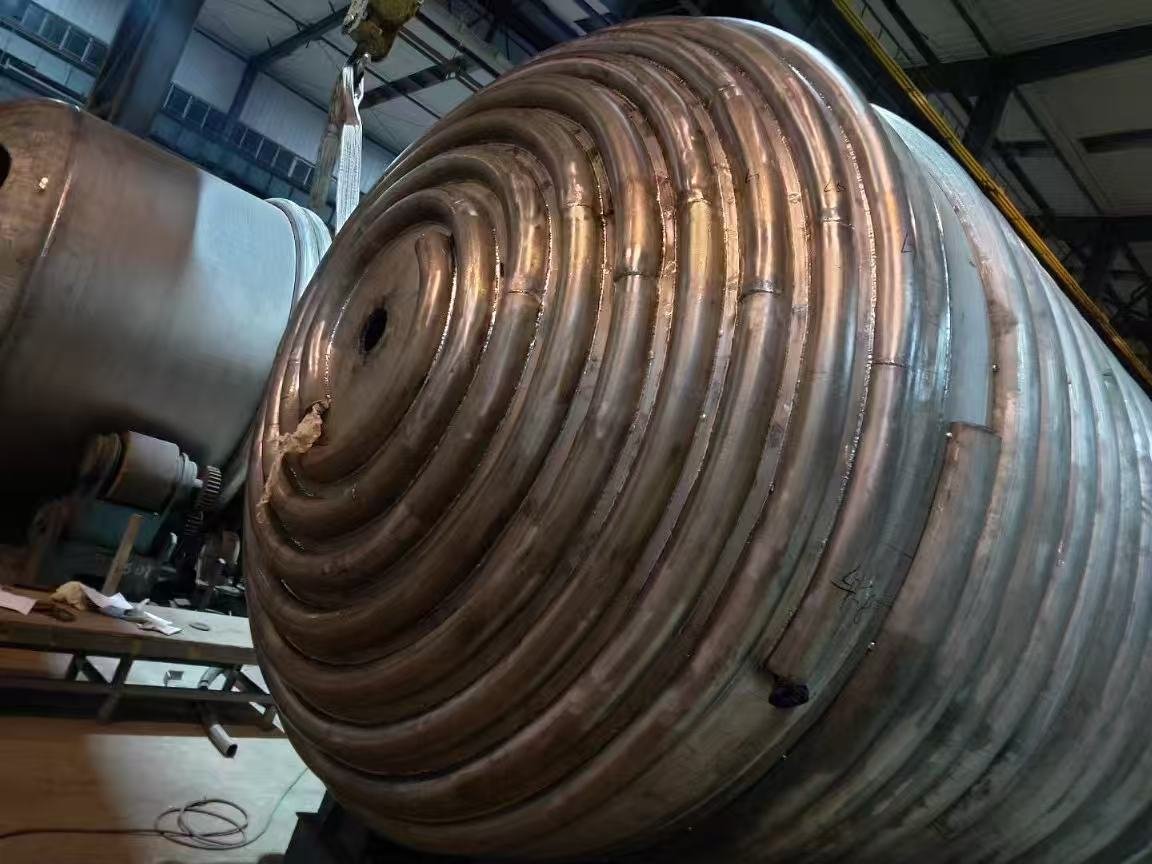
There is no minimum order quantity on a glass-lined reactor built in China. Vessels are fabricated to order across 50–30,000 L, and a single 3,000 L jacketed unit with a mechanical seal is a normal purchase at USD 8,000–14,000 ex-works — one unit, not a container load. What order size changes is not whether the vessel can be built, but how much of the engineering, firing cycle and inspection cost you carry on your own.
1. Why the usual MOQ logic does not apply
There is no mould. A glass-lined vessel is a rolled carbon steel shell, a formed head, a welded jacket, and a wet slurry lining fired onto a prepared surface. Nothing in that sequence needs a batch of fifty to be economic, which is why the industry quotes in single units and why a 50 L reactor and a 30,000 L reactor are both ordinary orders.
The one genuine batch step is the lining furnace. Firing is a cycle, not a continuous process, and a small vessel still occupies a furnace load and a full temperature profile of its own. On very small orders that cycle is a visible share of the price, and it is the honest reason a 50 L vessel looks expensive per litre.
2. What does have a minimum — and it is never the vessel
The minimums sit on components. Plate comes off the mill in standard thicknesses and full plates. Dished heads are formed on tooling sized to standard diameters. Cast agitator impellers need a pattern. Mechanical seal cartridges, PTFE-encapsulated gaskets and nozzle flanges are stocked in standard sizes and made to order in others.
This matters when you negotiate. If a supplier says a 300 L vessel carries a minimum of five, the constraint is not the vessel — it is a component, a furnace slot or a scheduling preference. Ask which one, and ask for it in writing.
3. What a custom size costs, in order of severity
Cheapest: straight-side height at a fixed diameter
The head former, the shell rolling rolls and the lining rack are unchanged. The vessel gets taller, volume goes up, jacket area goes up. Design pressure in MPa, lining thickness in mm and the high-voltage test in kV are unaffected by the height change.
Middle: jacket type and agitator
Moving from a plain jacket to an inner coil, an immersion tube or a half-pipe coil changes heat-transfer area and the nozzle layout. Agitator power follows the duty, not the volume: a 2,000 L vessel on a fast dispersion duty can carry a larger drive than a 5,000 L vessel doing a slow blend.
Most expensive: a non-standard shell diameter
A new diameter touches the head forming tool, the gasket and nozzle geometry, the furnace rack and often the hydrotest fixture. It also resets the heat-transfer and agitator calculations, because both scale with geometry rather than with litres.
Suppliers who publish a flat percentage surcharge for a non-standard size are pricing a risk, not a cost. Ask instead for the specification sheet with actual dimensions in mm, heat-transfer area in m², agitator power in kW and unit weight — those four figures explain the gap between two quotations faster than any percentage.
Rule of thumb: change the straight side before you change the diameter, and change the diameter before you change the material of construction.
4. Where the standard series stops and your drawing starts
Model designation and nominal volume follow the standard series, which is why quotations from different suppliers look comparable at the top line. Below the top line almost nothing is standard. Inner and jacket design pressure in MPa, design temperature in °C, sealing arrangement, nozzle count and position, lining thickness and the acceptance test are all set by your duty.
Those items are issued as a numbered specification confirmation sheet, and that sheet — not the quotation PDF, not the email thread — governs fabrication. If a supplier will not produce one, the conversation about custom sizes has not started.
5. How to change a drawing without paying twice
- Issue the duty, not the drawing. Medium and concentration, operating temperature and pressure, jacket service, solids and viscosity, agitation requirement, hygiene class. A supplier who receives your drawing instead of your duty will build your mistakes faithfully.
- Ask for the numbered specification sheet. One page, every parameter filled, no open ranges.
- Mark it up in one round. Comments collected from process, maintenance and procurement and sent together. Three rounds of small changes cost more engineering time than one substantial revision.
- Freeze it in writing. The approval date is the point where the drawing is released and plate is cut.
- Know what a post-freeze change costs. A nozzle moved before the shell is welded is a drawing revision. A nozzle moved after the lining is fired is a strip, a re-blast, a re-lining and a second furnace cycle — in practice, a new vessel.
6. Small orders, mixed consignments and the container trap
A 50 L or 100 L vessel does not fill a container, and freight per unit on a single small reactor is poor. The sensible answer is consolidation: one reactor, a storage tank, a condenser and a set of spare gaskets, specified together and shipped together under one set of documents.
The trap is letting the container drive the design. If the vessel is sized to fill a box rather than to run the reaction, the freight saving is repaid every day in the plant.
7. When the cheaper answer is the correct one
If your duty sits inside the standard model — moderate pressure and temperature, no aggressive solids, no stringent containment — take the standard nominal volume, the plain jacket and the packed seal. A packed seal is cheaper and defensible on a non-hazardous aqueous duty; the mechanical seal earns its cost where vapour release matters.
The harder honest answer: if your medium is hydrofluoric acid or fluoride-bearing, phosphoric acid at 30 % or above beyond 180 °C, or a strong alkali above pH 12 at 100 °C, no amount of customisation makes a glass-lined vessel the right purchase. Change material — PTFE lining or stainless — and spend the customisation budget there. Glass lining also carries thermal-shock limits of cold shock ≤ 110 °C and heat shock ≤ 120 °C, and no shell dimension changes that.
8. What to do next
- Write one page of duty data before you ask anyone for a price.
- Ask for the quotation broken out line by line: vessel, jacket, agitator, seal, lining, inspection and documents, freight. A blended number cannot be compared with anything.
- Ask for the numbered specification confirmation sheet and approve it once, in writing, with all comments inside it.
- If the order is genuinely small, say so early and ask what a consolidated shipment would carry. That is a logistics question, not an engineering one.
An MOQ question is usually a scheduling question wearing a technical coat. Whether you order one vessel or six, the real work sits in the specification sheet, the approval date and the inspection record — and that is where your attention belongs.