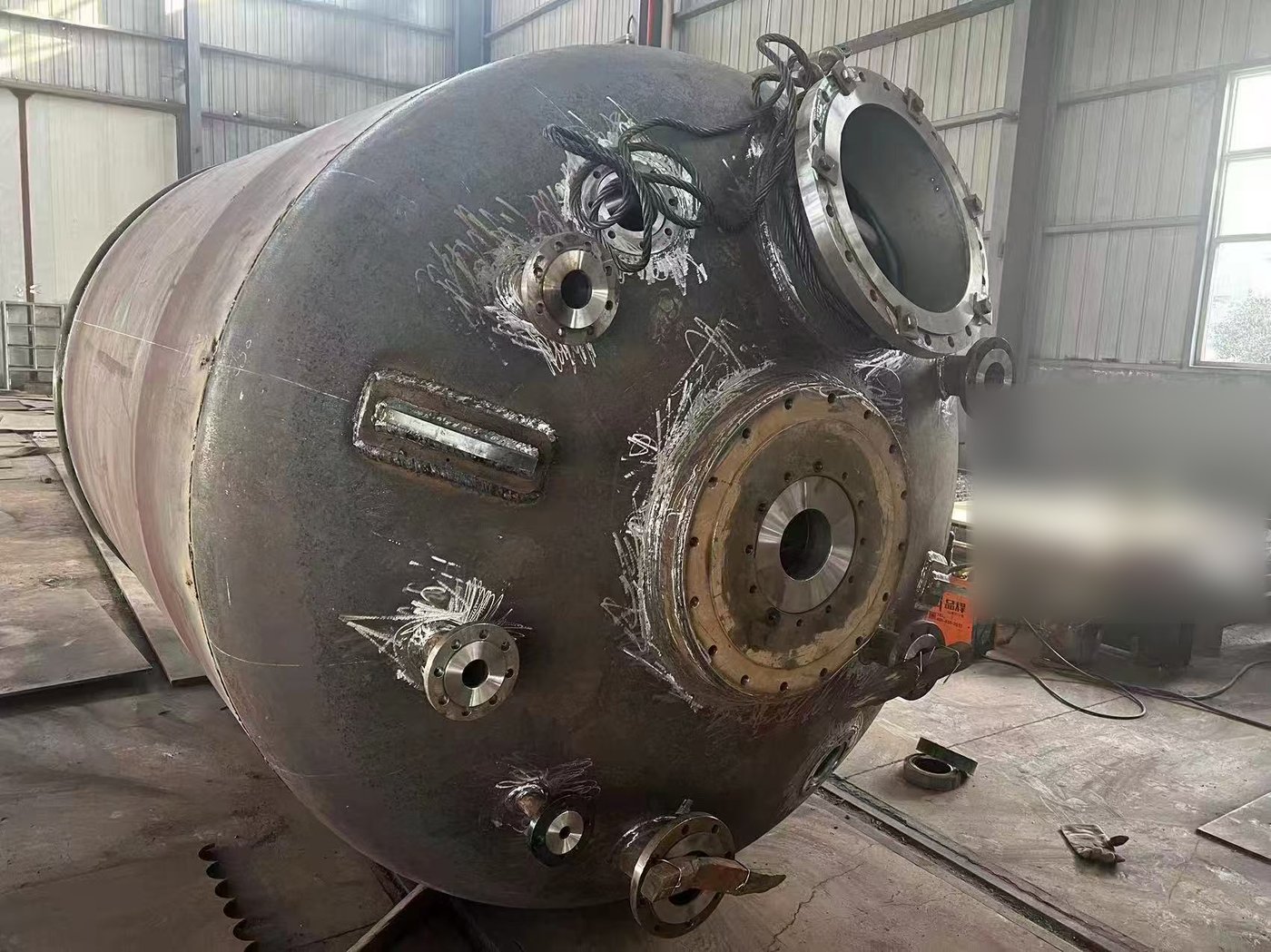
A 5,000 L jacketed reactor's five-year total cost of ownership is four numbers added together — purchase price, glass repair, re-lining or re-shelling, and the production days lost while the vessel is open — and on a glass-lined vessel the purchase price is rarely the largest of them. A 3,000 L jacketed glass-lined reactor with a mechanical seal lands at USD 8,000–14,000 ex-works; a 5,000 L sits above that band and has to be quoted. The comparison only becomes honest when all four lines sit on the same sheet, with your own downtime cost in the fourth.
1. Fix the scope before you argue about the numbers
Two quotations compare only if they describe the same vessel: 5,000 L nominal, jacketed, mechanical seal, same agitator type and power, same nozzle schedule, same design pressure in MPa and design temperature in °C. A glass-lined quotation with a packed gland against a stainless quotation with a double mechanical seal is not a price difference, it is two different machines.
Exclude civil works, installation, insurance and freight from both columns, or include them in both. Do not exclude the cost of a lost batch — that belongs in the downtime line, and it is usually larger than the repair that caused it.
2. Line one — the purchase price
Glass-lined is a carbon steel shell with a lining bonded to the wetted surface; 316L is solid corrosion-resistant plate. On a 5,000 L jacketed vessel at modest pressure, that normally makes the glass-lined unit cheaper to buy. It is not a law: a 316L quotation built on a thinner corrosion allowance, a 304 shell with 316L cladding, or a standard stock size can undercut a custom glass-lined build.
The gap is real, but it is not the decision. Ask both suppliers to break the price into the same six items so the two numbers can be read against each other, and get the glass lining thickness in mm and the high-voltage test voltage in kV onto the numbered specification confirmation sheet you approve before fabrication starts.
3. Line two — repair, and what actually breaks
Glass does not fail evenly. It fails at the agitator sweep where a bent blade or a dropped tool has touched it, at manway and nozzle edges, and wherever the vessel has been taken outside its thermal shock envelope — cold shock ≤ 110 °C, heat shock ≤ 120 °C. Those are the three places to look during inspection, and they are the three places the repair budget comes from.
Small damage is repaired in place with a field kit and confirmed with a spark test at the specified kV; anything structural goes back to a furnace, which is a scheduling problem as much as a cost problem. Stainless repair is a weld and a re-passivation, normally done in situ by a coded welder in days rather than weeks. That asymmetry, more than the per-repair price, is what the downtime line measures.
4. Line three — re-lining, and why five years hides it
A re-lining event on a 5,000 L vessel usually falls outside a five-year window, which is the single largest distortion in any five-year comparison in favour of glass-lined. Stainless has no lining to renew, but it does have a corrosion allowance that thins and chloride pitting that can perforate a shell.
Handle this honestly: ask the glass-lined supplier for a re-lining price in writing at the time of purchase, then run the sheet again at ten years with that number in it. If the supplier will not put a re-lining price in the quotation, that is information too.
5. Line four — the cost of a stopped reactor
This is the line buyers guess at, and it is the line that decides the answer. Get one number from finance: the contribution margin of the product that reactor makes, per day, or the cost of the bought-in intermediate that replaces it. Then multiply by the days the vessel is out.
A glass-lined vessel is not slower to repair because the repair is harder; it is slower because the damage is found at inspection, the repair decision needs a specialist, and heavy damage needs a furnace slot. Plan nine days and hope for five. A 316L vessel typically returns in two to four.
6. The sheet, with illustrative numbers
The figures below are arithmetic, not a quotation. Build your own sheet from three quotations and one number from your finance manager; the structure is the part that transfers.
- Purchase, ex-works — glass-lined 16,000 · 316L 21,000
- Seal faces and gasket sets, two changes — glass-lined 1,200 · 316L 1,200
- Lining repair, two events at 1,500 — glass-lined 3,000 · 316L 0
- In-situ weld repair and passivation — glass-lined 0 · 316L 900
- Inspection and testing over five years — glass-lined 1,000 · 316L 700
- Unplanned downtime at USD 2,500 per day — glass-lined 9 days = 22,500 · 316L 3 days = 7,500
- Five-year total — glass-lined 43,700 · 316L 31,300
Read the totals as a formula, not a verdict. Let G be the purchase-price gap (5,000 here), R the extra repair and inspection spend (2,400 here) and D the extra days of downtime (6 here). Glass-lined wins only while D × your daily downtime cost is smaller than G − R; here that break-even sits at USD 433 per day. At 2,500 per day, stainless is ahead by 12,400. At 400 per day, on a slow campaign with a cheap product, glass-lined is ahead.
That is the whole argument. It is not a material preference, it is a number that moves with your plant.
7. When the sheet stops mattering
Three duties end the calculation immediately. Hydrofluoric acid and fluoride-bearing media attack glass; phosphoric acid at 30 % or above, above 180 °C, attacks it; strong alkali above pH 12 at 100 °C attacks it. In those services the question is stainless or PTFE-lined, not glass-lined, and no five-year sheet changes that.
Two more push the other way. Abrasive solids wear the lining at the agitator sweep, and repeated excursions beyond the thermal shock limits crack it. If your process does either regularly, the glass-lined column will not look like the one above.
8. What to do next
Write the specification once — 5,000 L, jacket, seal, agitator, design pressure in MPa, glass lining thickness in mm, HV test in kV — and send the identical document to both suppliers. Then fill the four lines with your numbers, not ours. If the sheet still comes out close, buy on the repair and re-lining terms, because that is where the next five years will actually be decided.