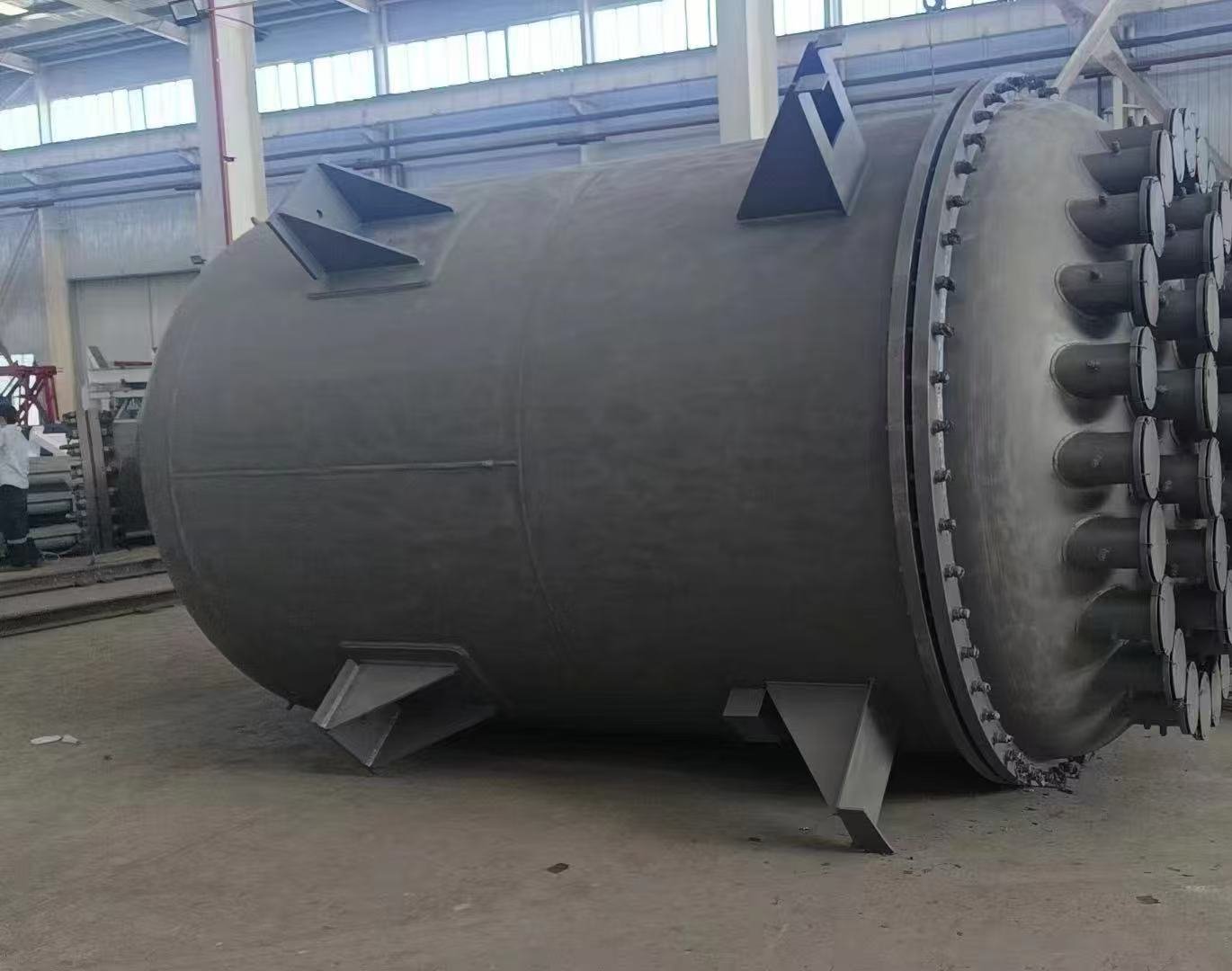
A glass-lined storage tank holds a corrosive liquid at atmospheric pressure; a glass-lined reactor also mixes it, heats or cools it through a jacket, and seals a rotating shaft. If the duty is holding only — no agitation, no heat transfer, no pressure — the tank is the correct purchase: a 3,000 L glass-lined reactor with a jacket and mechanical seal costs USD 8,000–14,000 ex-works, and the storage tank version of the same nominal volume deletes the drive, the seal and the jacket from that figure.
1. Four components separate a tank from a reactor
Strip these out of a glass-lined reactor and what is left is a storage tank with a manhole.
- Agitator and drive — shaft, impeller, gearbox, motor, support bracket, and the baffles or dip pipe that go with them.
- Shaft seal — packed gland or mechanical seal, with lantern ring, flushing or quench connection and the nozzle to carry it.
- Jacket — dimple or half-pipe jacket, its inlet and outlet nozzles, and the secondary-side pressure rating that comes with it, typically 0.6 MPa on Chinese glass-lined reactors.
- Pressure rating and nozzle set — inner vessel designed to roughly 0.2–0.4 MPa instead of atmospheric, with instrument, return, dip-pipe and vent nozzles placed for a process rather than for filling.
Everything else — the steel shell, the glass lining, the manhole, the legs or lugs — is common to both. That is why the price gap is smaller than buyers hope and larger than a tank supplier's quotation first suggests.
2. The lining is identical, and so are the limits
Both vessels carry the same glass lining, applied the same way and tested the same way. Both must respect the same media limits: inorganic and organic acids, organic solvents and weak bases at various concentrations, but not hydrofluoric acid or fluoride-bearing media, not phosphoric acid at 30 % or above above 180 °C, and not strong alkali above pH 12 at 100 °C.
A storage tank is not a way around those limits. Holding 30 % sodium hydroxide at 60 °C in a glass-lined tank attacks the lining exactly as it would inside a reactor. If the medium sits outside the list, the answer is PTFE lining or a different shell material, not a cheaper vessel.
The high-voltage test, the lining thickness and the thermal-shock limits are properties of the lining, not of the vessel type. A storage tank is not built to a lower inspection standard; it is simply built without the parts that see the harder duty.
Thermal shock is where the two actually diverge. The lining tolerates cold shock up to 110 °C and heat shock up to 120 °C. A jacketed reactor pushes heat through the wall and is the harder case. A tank with no jacket has a one-sided gradient — but charging hot liquid into an empty cold tank can still exceed the 110 °C cold-shock limit, and the damage shows up as a crazed patch around the inlet nozzle.
3. Where the money goes
Rule of thumb: a glass-lined storage tank of the same nominal volume quotes at roughly half to two-thirds of the reactor price. On a 3,000 L basis that is a saving in the region of USD 3,000–5,000 ex-works — confirm it against a line-by-line quotation rather than a lump sum, because lump sums hide which parts were removed.
Our quotations split the vessel into line items: shell, lining, agitator and drive, seal, jacket, nozzles and fittings. Put a reactor quotation and a tank quotation side by side and the entire gap sits in the middle four lines.
A tank quoted as atmospheric is not a downgraded reactor. It is a different calculation, and it should not be built from a reactor drawing with the jacket taken off — the nozzle spacing, the support arrangement and the manhole position all follow from how the vessel is used.
4. When a storage tank is enough
Specify the tank when all of the following are true:
- The liquid only needs to be held — no reaction, no dissolution, no crystallisation.
- Nothing settles. There is no agitation to re-suspend solids, and a cone bottom drains but does not lift a settled layer.
- Temperature stays inside the lining limits without a jacket, or can be corrected upstream or in the transfer line.
- The vessel sees atmospheric pressure or a few kPa of blanketing gas — not vacuum, not pressure.
- No gas must be stripped out of the liquid or dissolved into it.
- Cleaning is by fill-and-drain or a spray ball rather than by agitation.
This covers solvent hold tanks, acid day tanks, brine and caustic storage, and buffer capacity between unit operations — where most glass-lined vessels in a plant actually sit.
5. When it is not enough, even when it looks like it should be
Five duties that get quoted as storage and come back as a complaint:
- Suspension that must stay suspended. Solids settle in minutes to hours; a dip pipe draws clear liquid and leaves the rest behind.
- Blending after a batch. Two deliveries of the same product at slightly different assay will not mix in a tank. Stratification can persist for days.
- Heat of dilution. Caustic and acid dilution release heat that a jacketed vessel must remove and an unjacketed one cannot.
- Vacuum or pressure transfer. Draw the tank under vacuum, or push it with nitrogen above a few kPa, and it stops being a storage tank and becomes a pressure vessel with a design calculation to match.
- Inerting with a mixing requirement. Blanketing protects the product; it does not homogenise it.
6. The halfway build
There is a legitimate middle: a storage tank with an agitator but no jacket, or a jacketed tank with a slow paddle instead of a full agitator system. Each addition is quoted as its own line, so you can weigh the cost of the feature against the benefit it delivers.
A tank with a slow-turning paddle and a dip pipe often solves stratification for a fraction of a reactor. A jacketed tank with no agitation gives you temperature control on paper only — the product-side film is the bottleneck, and a still liquid uses far less of the jacket area than the square metres suggest.
7. What to put on the enquiry
Whether you ask for a tank or a reactor, six lines settle the price:
- Nominal volume in litres, and the working volume you actually fill to.
- Design pressure and design temperature for the inner vessel, in MPa and °C, and whether a jacket exists and at what pressure.
- Medium, concentration and operating temperature, checked against the lining limits in section 2.
- Agitation: none, or impeller type, speed in rpm and motor power in kW.
- Nozzle schedule, manhole size, and any finish or cleaning requirement.
- Applicable standard and inspection: GB/T, PED or ASME, and whether third-party inspection such as SGS is required.
We issue these back as a numbered specification confirmation sheet, which you approve before fabrication starts. That sheet is what the vessel is built against, and what the inspector checks against on the day.
8. What to do next
Write the duty down before you write the specification: what goes in, what comes out, at what temperature, and what must have changed in between. If nothing changes, specify the tank and keep the difference. If anything mixes, heats, dissolves or must be held in suspension, the reactor is not an upgrade — it is the minimum requirement.
Send us the duty and we will quote both builds, line by line, from our office in China, so the decision rests on a number on a page rather than an instinct.