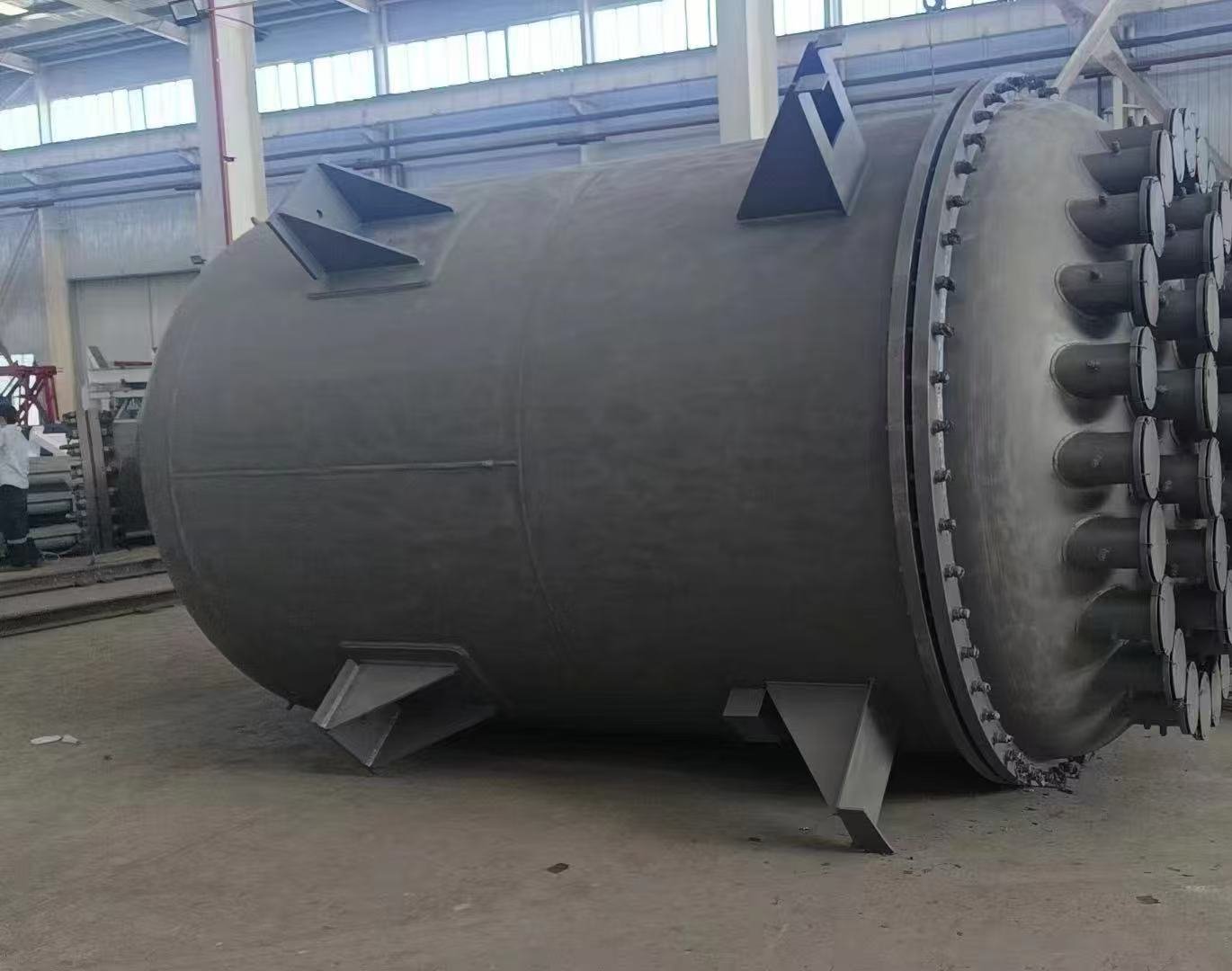
Electric heating suits a glass-lined reactor when there is no steam boiler on site, when the vessel is small (50–2,000 L), or when the duty needs jacket temperatures above the 165–184 °C available from 0.6–1.0 MPa(g) saturated steam. The arithmetic is fixed: heating 2,500 kg of water-like product from 20 °C to 80 °C takes 174 kWh, so doing it in three hours needs about 58 kW of net heat and roughly 70–75 kW of installed element load. Electricity usually costs more per kWh than boiler gas, so specify it for site simplicity and control, not for running-cost savings.
1. Where electric heating is the right answer
Most electric-heated glass-lined vessels are not chosen for efficiency. They are chosen because the alternative does not exist yet.
- No boiler, or a boiler already at full load. A 500 L reactor with 1.5 m² of jacket area does not justify a steam plant, feedwater treatment and a boiler operator.
- Jacket temperature above 200 °C. Saturated steam at 1.0 MPa(g) stops at about 184 °C. A duty running at 220–250 °C cannot reach it without a far higher-pressure boiler, and an electric thermal oil heater can.
- Intermittent batches. A boiler kept warm all week for two batches a day burns fuel doing nothing. An element draws nothing when it is off.
- No combustion permit. Flammable atmospheres, cleanrooms, pilot halls and some leased buildings will not accept a burner and a flue. An electric heater has neither.
- Tight ramps. Crystallisation and polymerisation duties calling for 0.5–2 °C/min are easier to hold with a resistive element than with a steam control valve.
It is the wrong answer when the vessel is large and the heat-up is fast. A 5,000 L vessel asked to heat 4,000 kg through 60 K in one hour needs about 280 kWh in that hour, which is roughly 350 kW installed and about 500 A at 400 V three-phase. At that point the electrical supply upgrade costs more than the boiler.
2. How to size the connected load
The calculation is one line. Energy in kWh equals mass in kg, times specific heat in kJ/kg·K, times the temperature rise in K, divided by 3,600.
For water-like product, cp is 4.18 kJ/kg·K. A 1,000 L vessel with an 800 kg charge, heating from 20 °C to 80 °C, needs 800 × 4.18 × 60 ÷ 3,600 = 56 kWh. Spread over two hours that is 28 kW of net heat. Add 25 % for the steel shell, the jacket oil and standing losses, and the installed load is about 35 kW.
Run the same sum on a 3,000 L vessel with a 2,500 kg charge and you get 174 kWh — 58 kW net over three hours, about 73 kW installed. A solvent with cp near 2 kJ/kg·K halves both figures.
Then convert to money. That 3,000 L vessel at 174 kWh a batch, one batch a day, 300 days a year, is 52,200 kWh before losses. Multiply by your delivered industrial tariff. This is the only number that decides the electric-versus-steam argument.
3. What the kWh figure leaves out
The 25 % allowance is a rule of thumb, not a design value. Ask for the real figure from the vessel weight and the jacket oil volume on the drawing, because a heavy jacketed vessel with a large oil fill loses more than a light one.
Three things change the answer completely. An endothermic reaction adds its heat of absorption to the duty and can double it. An exothermic reaction makes the element a trim heater only, with cooling as the design case. And a reflux duty means part of the energy leaves with the vapour and returns in the condenser — the element pays for it twice.
4. Electric, steam and thermal oil, side by side
- Steam is the cheapest heat per kWh if a boiler already exists, and gives the highest flux per square metre of jacket, which keeps vessels small. It stops at the saturation curve: about 165 °C at 0.6 MPa(g), about 184 °C at 1.0 MPa(g). It brings feedwater treatment, traps, insulation, a flue and periodic inspection.
- Thermal oil reaches 300 °C and above at atmospheric pressure, so the jacket wall stays modest in thickness. It needs a heater, a circulation pump, an expansion tank and scheduled oil replacement. If the oil is heated by gas, you have kept the burner and the flue — you have only moved them outside the reactor.
- Electric has the highest running cost per kWh and the lowest balance of plant: no water treatment, no flue, no flame, no idling loss, and control that holds a setpoint within a degree. If you want oil temperatures without a burner, an electric thermal oil heater is the same circuit minus the combustion.
The honest summary: steam wins on running cost, thermal oil wins on temperature, electric wins on installation and control. Many small and mid-size glass-lined vessels in China are ordered with electric heating because they go into plants that have no boiler at all.
5. The lining limit that decides the control scheme
Glass lining is rated for cold shock up to 110 °C and heat shock up to 120 °C. That is the maximum temperature difference the coating will take across its thickness, and it constrains the heating design more than the element does.
Pouring 300 °C oil into the jacket of a vessel charged at 20 °C puts a 280 K difference across the wall — more than twice the heat-shock rating, and a lining failure in one step. The rule that follows: hold the jacket medium within about 100 °C of the product temperature, and ramp in steps on a cascade controller, with the rate in °C/min written into the operating procedure.
If a supplier quotes an electric-heated glass-lined vessel without asking your charge temperature and how fast you want to reach setpoint, the heating design is not finished.
Local hot spots matter as much as bulk temperature. Elements sitting in a jacket of still oil create a film far hotter than the bulk, and that film touches the back of the glass. Ask for the element watt density, the jacket oil volume and whether circulation is pumped or by natural convection. Low watt density and a pump cost more, and are worth it.
6. Cooling is the half that electric heating does not solve
Most glass-lined reactors need to cool as well as heat — after an exothermic step, before discharge, or to hold a setpoint. An oil-filled jacket is poor at this. Three options exist: a separate cooling circuit in the same jacket, an inner coil or half-pipe coil on a second circuit, or an oil-to-water exchanger in the circulation loop.
Whichever you choose, the 110 °C cold-shock limit still applies. Dumping 15 °C cooling water into a jacket at 200 °C is the same mistake in reverse, and changeover between oil and water needs its own written procedure.
7. What to put on the specification sheet
- Connected load in kW, split into steps (for example 3 × 25 kW) so the supply can be shared and turndown is real.
- Voltage, phase and frequency, with the current draw stated. A 90 kW load is about 130 A at 400 V three-phase.
- Element watt density, jacket oil volume, and whether circulation is pumped or natural.
- Oil grade, maximum bulk and film temperature, expansion tank volume, low-level cut-out.
- Control arrangement: product Pt100 and jacket Pt100, cascade to the element, ramp rate in °C/min, over-temperature cut-out.
- Maximum permitted ΔT between jacket and product, in writing, and the charging range that keeps the lining inside it.
- Cooling route and its own ΔT limit.
- Jacket design pressure in MPa, design temperature in °C, and the high-voltage test figure in kV for the lining.
None of this is exotic. It is the difference between a heating package that works on day one and a lining argument in month four. We issue it as a numbered specification confirmation sheet that you approve before fabrication starts.
8. What to do next
Start from your duty, not from a catalogue. Write down the charge mass, the specific heat, the start and end temperature, the time allowed for heat-up, and the supply you actually have at the wall.
Then run the kWh sum, multiply by your tariff, and set that annual figure against your boiler's fuel bill. If the gap is small and you have no boiler, electric is the answer. If the gap is large and you already have steam at 1.0 MPa(g), use the steam.
Send us the five duty numbers and we will size the element, the jacket and the control scheme, and quote the heating package line by line alongside the vessel — a 3,000 L glass-lined reactor with jacket and mechanical seal lands at USD 8,000–14,000 ex-works before the heating package is added. Confirm every figure on the drawing before you release it for fabrication.